
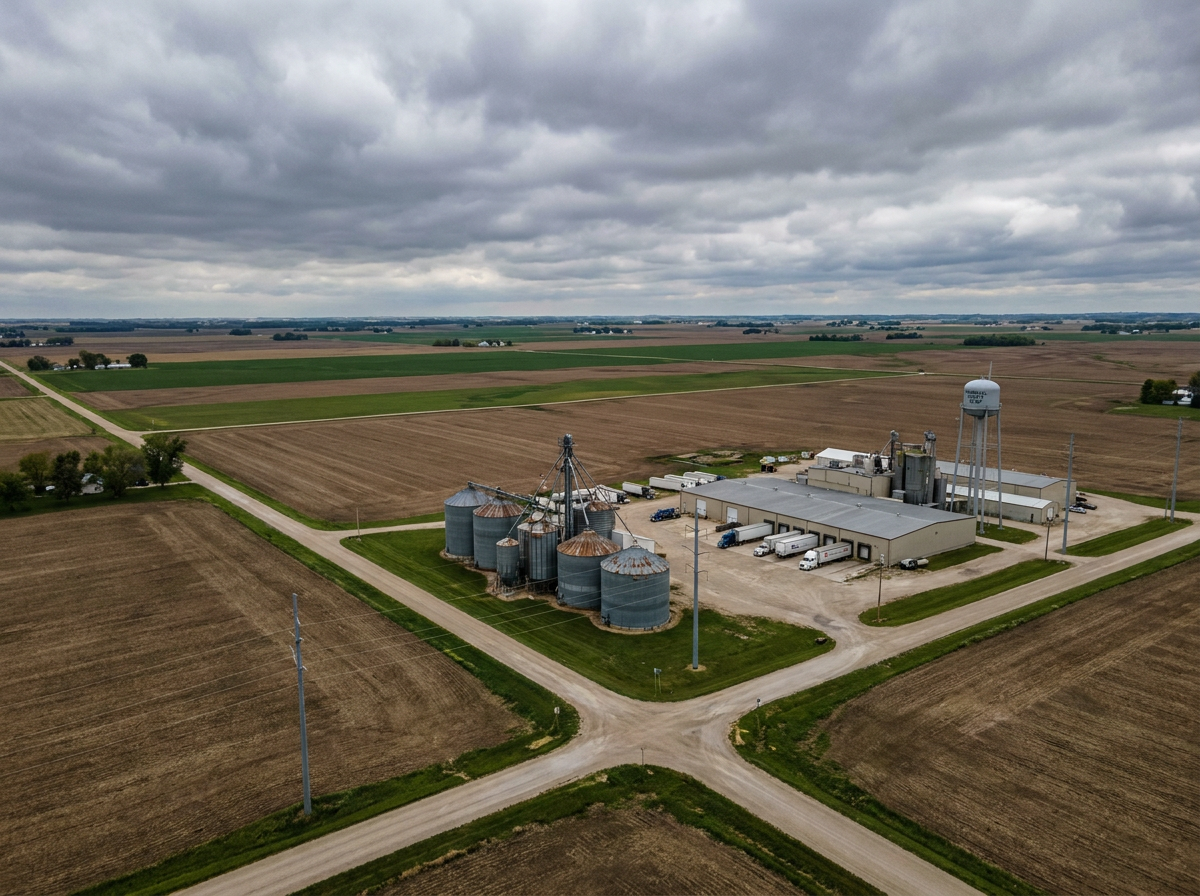
Eight Sites Failed the Same Utility Gate for the Same Reason.
And that one finding outranked every construction project in the region.
How we scored eight rural Midwest sites against ag-processing demand in 25 calendar days — and found that the cheapest readiness gain wasn't concrete.
01. The Situation
The Client
An eight-county rural Midwestern ag accelerator region, contracted through a county economic development organization acting as fiscal agent. Eight rural counties held industrial ground they believed was competitive for value-added food and beverage processing. None of them could prove it in the form a corporate site selector reads.
The Problem
- The region needed a ranked shortlist of the sites worth its next public capital dollar — defensible enough to carry into a competitive state funding round.
- It needed that answer in twenty-five calendar days, on a date fixed by the funding rather than by the schedule.
- A conventional assessment of this size runs three to four months. There was no float.
- Five of the critical-path dates belonged to the counties rather than to us — and missing returns were documented as gaps rather than waited for.
At a Glance
Why General Site Certification Is the Wrong Instrument
General-purpose site certification is built for industrial real estate. Ag processing is a different underwriting problem — and the three gaps in the standard instrument are precisely where processors get surprised.
02. The Approach — Six Tasks, One Rule
Every weight fixed before scoring; every tier assigned by gate rather than by average. Nothing downstream re-opens a closed gate.
Orientation & Standard
Weights fixed and publishedHalf-day working session with all eight economic development directors. The full 28-criterion matrix, its weights and the five processing-archetype demand profiles issued in the room — so every county knew exactly what was being graded before grading began.
Target-Industry Fit
Archetype demand profile lockedA one-page finding per county naming the processing subsector its raw materials, infrastructure and labor shed can genuinely win, scored against five facility archetypes rather than asserted from cluster data.
Pre-Tour Data Collection
Unconfirmed carried as unconfirmedStandardized site and utility questionnaire per county, built to the region's existing data format, plus desk review of GIS, zoning, floodplain, wetlands and prior studies. Missing returns were documented as gaps rather than waited for — the mechanism that protected the deadline for the other seven counties.
Site Tours
Site substitution window closesEight sites across three field days, ninety minutes each, with the county director, the owner or representative, and at least one utility representative present on the ground.
Readiness & Gap Analysis
Tier by gate + binding constraintEvery site scored to 100 points across ten categories, then assigned a tier by conjunctive gate. Each failed site carries one named binding constraint, and every gap is sequenced and costed into a roadmap step with an owner, a lead time and a named funding program.
Coaching & Regional Wrap-Up
Applicant + program tested per projectWorking session on site marketing, RFI response and presenting to site consultants — run against a real RFI, not a generic example — plus the regional comparative matrix, prioritization recommendation and the board presentation.
03. Where the Hundred Points Sit
Weighting reflects what a food and beverage engineer underwrites, not what a general-purpose certification measures. Water and wastewater together carry 31 points — nearly a third of the instrument.
Six of the twenty-eight criteria are also gates: a site holds a tier only if it clears every one of them independently, regardless of total score.
Roads, power and rail carry the total. The fatal flaw averages away.
Reads as a strong site. A processor cannot use it at any price on a project timeline.
Identical inputs. The zero is a gate failure, so it caps the tier outright.
Binding constraint named, sequenced and costed. One thing to go fix.
The weights are the argument. A weighted total is compensatory by nature. A site can reach 78 out of 100 while scoring zero on high-strength wastewater acceptance — and that is precisely the deal-killer the instrument exists to flag. Tier assignment is conjunctive: the score ranks sites within a tier, it does not confer one.
04. The Three Moves That Made the Difference
Methodology is not differentiation. The execution of it is. Three specific decisions kept this assessment credible — across eight jurisdictions, in 25 days, with five critical-path dates outside our control.
Weights Fixed and Published Before Scoring
All twenty-eight weights, the six gate thresholds and the two score floors were set, dated and issued to the counties at the orientation workshop, then carried unchanged through every calculation.
This is the cheapest available defense against the primary methodological risk in a multi-jurisdiction assessment: quietly adjusting a threshold once a county does not like its answer. When a site failed a gate, nobody could argue the goalposts had moved — and nobody did.
Gates Before Averages
A weighted total is compensatory by nature. A site can reach 78 out of 100 while scoring zero on high-strength wastewater acceptance, carried there by roads, power and rail — and that is precisely the deal-killer the heaviest criterion exists to flag. Tier assignment is therefore conjunctive: the score ranks sites within a tier, it does not confer one.
Not “this site looks strong,” but “this site cannot host the archetype until the receiving plant demonstrates headroom, and here is the specific investment that reopens it.”
One Binding Constraint Per Site
Where a site fails one or more gates, the assessment names a single binding constraint — the highest-priority failed gate, ordered by which one a processing prospect would encounter first: acceptance, then treatment headroom, water capacity, site control, entitlement, due diligence, score floor.
Resolving anything below the binding constraint does not advance the site, and each roadmap is sequenced accordingly. A county director has one line to act on — not a ranked list of eight gaps to argue about.
It is the one line to put in front of a county director. It converts an argument about the grade into a specific thing to go fix.
05. What We Found
Not one of the eight sites held a written utility capacity confirmation.
Not a single capacity letter, for any utility, anywhere in the region — sitting directly behind the two most heavily weighted criteria in the standard. These are the findings that actually changed the region's strategy.
One Absence Failed the Water Gate at Every Site in the Region
Applied consistently, the absence of a written utility capacity letter failed the water capacity and treatment headroom gates at all eight sites. It capped the region's strongest site a full tier below where its infrastructure alone would have placed it.
An unknown scored as a failure is not the same as a confirmed failure. The distinction was reported as a regional finding rather than buried as a data-quality footnote in eight separate reports — because it changes what the first dollar should do.
A community that cannot confirm its utility capacity in writing is competing at a disadvantage against communities that can. The letter is not the investment — it is the permission to make the investment credible.
The Cheapest Readiness Gain Was Not Construction
Four confirmation steps across four counties — meetings and letter requests — under sixteen thousand dollars combined, moved more scored criteria than any single construction project in the eight roadmaps. One of them moved a tier.
Those steps were sequenced ahead of the funding applications, because they can reprice or invalidate the work behind them. You do not pour a foundation before you know whether the utility can serve the building.
The right projects were not the highest-scoring sites. The region's largest capital asks were not grant-addressable, and its highest-scoring site needed no construction at all.
We Named Where Grant Dollars Cannot Go
One site carried an eight-figure utility requirement with no established utility owner — and therefore no eligible applicant for any state or federal program, at any merit level. That is a governance problem before it is a money problem, and no scoring exercise surfaces it.
This finding was not softened. Three projects were recommended for the next funding cycle, each tested against three questions: does it clear a gate rather than lift a score, is there an eligible municipal applicant already in place, and does a named program actually reach the number. That test removed most of the region's biggest line items.
A prioritized list that never rules anything out is a marketing document, not a strategy.
06. What the Client Received
A ranked shortlist of the sites worth the next capital dollar, three funding-ready projects with an eligible applicant and a named program behind each, eight costed and sequenced county roadmaps, and eight directors who can answer an RFI without calling anyone.
County Site Assessments × 8
Where each site actually stands — tier, gate results, binding constraint, evidence. Candid because it is not the marketing piece.
Public Site Profiles × 8
What a county can hand a prospect — marketing-ready specifications only. Separate from the assessment so the public document never becomes a liability in a public-records request.
Target-Industry Fit Findings × 8
Which processing subsector each county is positioned to win, and why — scored against five facility archetypes rather than asserted from cluster data.
RFI Response Shells & Tour Checklist
How a director answers a live RFI without calling anyone. Run against a real RFI at the coaching session, not a generic example.
Comparative Matrix & Prioritization Recommendation
Where the next public dollar goes — and where it cannot go, with reasons. Three projects recommended for the next funding cycle, each with an eligible applicant and a named program.
Readiness Roadmap & Board Presentation
71 sequenced steps with costs, owners, lead times and named funding programs. Not a recommendations slide — an execution plan. Delivered one day ahead of a deadline that could not move.
07. Transferable Insights
The next quarter's work is execution, not study. But every engagement produces findings that extend beyond the specific client. These apply to any regional EDO, multi-county accelerator, or utility ED team working on ag-industrial or food and beverage processing recruitment.
The utility capacity letter is not a formality.
It is the gate. A site can score in the 70s and still be unable to host a processor — not because the infrastructure does not exist, but because existence and confirmation are not the same thing. Confirmation is the investment.
General site certification is the wrong instrument for ag processing.
Food and beverage processing demands wastewater acceptance, supply shed position, and process-specific utility capacity — none of which a standard certification tests. Scoring against the right criteria produces different answers than scoring against the available ones.
Sequencing matters more than size.
Under $16K in administrative steps moved more scored criteria than any single construction project in the region. The question is not how much to spend. It is what to fix first — because some investments reprice the ones that follow them.
A prioritized list that never rules anything out is a marketing document.
The governance finding — no eligible applicant, no eligible program — is the most useful sentence in the report. It saves the region from spending political capital on a project that no funding mechanism can reach.
Publish the weights before you score.
In a multi-jurisdiction assessment, the moment a county director disagrees with its result is the moment the methodology gets questioned. Thresholds set in advance, in writing, with all parties in the room, are not arguable. Set them in the room before grading begins.
You Don't Need Another Inventory of Sites You “Should” Be Marketing.
You need to know which ones a processor can actually use, which single constraint is the one that matters at each, and what specific investment would change the answer. That is the work.
Start a Conversation →Client and site identities withheld by agreement. Findings are summarized at the regional level; site-level scores, tier assignments, ownership information and comparative rankings are excluded. Cost figures are order-of-magnitude planning ranges detached from any individual site.