
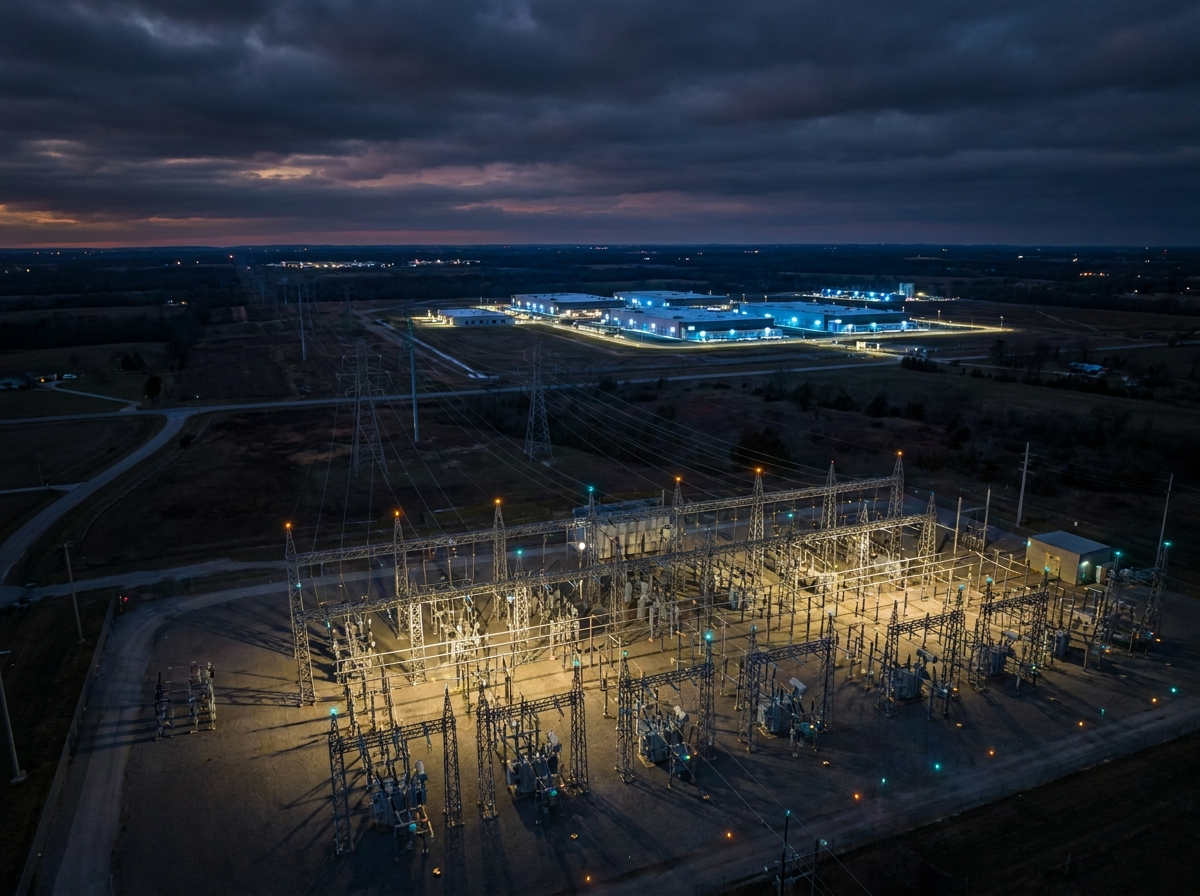
There is a version of the data center site selection pitch that still circulates in economic development offices across the country. It leads with acreage. It has a slide about fiber. It mentions tax abatements early and often. The community has done its homework: the site is zoned, the environmental phase one is clean, and the county assessor is on speed dial. By any conventional measure, it is a shovel-ready site.
The developer's power team dismisses it in forty-five minutes.
This is not a hypothetical. It is a pattern that has repeated itself — and continues to repeat itself — as the structural mismatch between data center capital deployment timelines and the realities of the North American transmission grid grows wider every year. Communities are still pitching the deal they used to close. Developers are underwriting a completely different one.
Understanding the gap requires understanding one thing in particular: the interconnection queue, what it actually means for a project's viability, and why it has become — not location, not incentives, not labor — the first fatal flaw screen for any serious data center siting exercise.
“Shovel-Ready” and “Power-Ready” Are Not the Same Thing
The term “shovel-ready” has a clear meaning in economic development. It describes a site that has cleared the entitlement, environmental, and infrastructure prerequisites that typically slow a project's early development phase. Grading permits. Utility stub-outs. Road access. The work that would otherwise consume twelve to eighteen months of a project timeline before a shovel touches dirt.
For most industrial uses, shovel-ready is a meaningful distinction. A manufacturer evaluating competing sites genuinely benefits from knowing that Site A has completed its environmental baseline studies and Site B has not. That time savings is real and it maps directly onto the project's capital deployment schedule.
For a hyperscale data center, the concept breaks down. Not because entitlement and environmental work are unimportant — they are — but because those elements are no longer the binding constraint on when a project can go operational. The binding constraint is when the project can receive power at the scale and reliability the facility requires. And that constraint is governed not by what the community has done to prepare the site, but by where the project sits in a queue managed by an independent system operator or regional transmission organization that does not answer to the community, the developer, or the county assessor.
A site can be fully entitled, environmentally clean, and construction-ready in ninety days. If the project cannot reach commercial operation on utility-supplied power for four years, the developer has a construction project without an operating facility. For an asset class where return on invested capital is calculated in kilowatts of revenue-generating load, that is not a delay. It is a deal-breaker.
What the Queue Actually Is, and Why It Matters More Every Year
When a large electricity consumer — a data center, a manufacturing facility, a utility-scale battery storage project — wants to connect to the transmission grid, it cannot simply plug in. It must submit an interconnection request to the relevant ISO or RTO: PJM, MISO, SERC, CAISO, ERCOT, and so on, depending on geography. That request enters a queue, and the queue determines the order in which interconnection studies are conducted, the costs assigned to the applicant, and ultimately when the project can begin drawing power from the transmission system at the requested load level.
The queue was always a constraint. In the current environment, it has become a crisis. PJM — which covers a swath of the Mid-Atlantic and Midwest including parts of thirteen states and the District of Columbia, and which represents some of the most coveted data center geography in North America — had, at last count, a queue backlog measured in years, not months. Projects that submitted interconnection requests in recent cycles are looking at three to five years or more before reaching commercial operation through the standard interconnection process, and in some submarkets the outlook is worse. MISO's situation is comparable. SERC markets are not immune, though the constraint profile varies by subregion.
The source of the backlog is structural and not easily resolved. Grid operators were designed to manage a relatively stable, generation-dominated interconnection request volume. What they are now processing is an explosion of requests driven simultaneously by renewable energy development, battery storage, and load growth from data centers, EV charging, and domestic industrial reshoring. The queue management rules themselves have been criticized for creating a dynamic where speculative projects occupy queue position ahead of serious ones, further compressing the bandwidth available for load interconnections. FERC has taken steps to reform queue processes — Order 2023 being the most significant recent intervention — but reform and results are not the same thing, and the queue remains one of the most significant supply-side constraints on large load deployment anywhere in the country.
For a data center developer with a twenty-four to thirty-six month development target — and the capital commitments that come with it — a five-year queue position is not a planning challenge to be managed. It is a project-killer that surfaces in the first thirty minutes of a site evaluation if the community does not surface it first.
Transmission-Level Constraints vs. Distribution-Level Constraints
The queue discussion above addresses transmission interconnection: the process for connecting to the high-voltage backbone of the grid. But there is a second, distinct set of constraints that operates at the distribution level, and the distinction matters because communities often conflate them or, more commonly, simply do not know which problem they have.
A project connecting at the transmission level — which any data center above roughly fifty megawatts of planned load will typically be, and which hyperscale campuses often do at two hundred, three hundred, or five hundred megawatts and above — is dealing with substation interconnection, new or upgraded transmission facilities, and the queue processes described above. The issues here are queue position, transformer availability, and the cost allocation for any required network upgrades. These can be project-defining in terms of timeline and capital cost, and they are governed by the ISO/RTO, not by the local utility.
A project connecting at the distribution level — smaller in load, drawing off existing distribution infrastructure rather than connecting at a new or upgraded transmission substation — faces a different set of constraints. Available distribution capacity, substation loading, feeder reliability, and local transformer inventory are the relevant variables. Distribution-level constraints are typically faster to assess and faster to remedy than transmission-level ones, but they also cap the scalable load that a site can ultimately support. A distribution-fed data center that needs to expand is not a distribution-fed data center for long.
The reason this distinction matters for communities is simple: most do not know, with any precision, which situation they are in. The utility economic development team can tell a developer that “power is available,” which is true in the sense that the lights are on in town, without that statement saying anything meaningful about whether the site in question can support a fifty-megawatt interconnection in the project's timeline, or whether a new transmission substation is required, or what queue position that substation project would need to secure. A community that cannot answer those questions in specific terms before the RFP is a community that is going to lose to one that can.
What the Developer's Power Team Is Actually Evaluating
Data center developers bring dedicated power and infrastructure teams to site evaluations, and those teams are running a specific screening protocol that bears very little resemblance to the standard economic development site tour. The questions they are asking, and the information gaps that kill interest early, are consistent across projects.
The first priority is the substation audit. What substations serve the site? What is the current loading on those substations, and what capacity do they have available? What is the rated voltage and configuration? Has the utility conducted recent load flow studies for the relevant service area, and are those studies available? The developer is trying to understand, before any formal interconnection study is commissioned, whether the transmission infrastructure in proximity to the site can physically support the project's load requirement without a rebuild that would take years to permit, procure, and construct.
Available fault current is a related technical screen that fewer communities understand. Fault current availability determines whether a site can support the switchgear and protective equipment that a large data center requires. It is not a question the community's economic development director can answer — but it is a question the utility's substation engineering team can answer, and a community that has already asked the question and can provide the answer is a community that has earned credibility with a developer's power team.
Transformer lead times deserve more attention than they typically receive in community preparedness discussions. The supply chain for large power transformers — specifically the high-voltage units required for transmission substation builds and upgrades — is not a twelve-week problem. Lead times for large power transformers have been running in the range of two to three years, driven by global demand, constrained manufacturing capacity, and supply chain disruptions that have proved stickier than initially anticipated. A project that requires a new substation, or a significant upgrade to an existing one, needs to account for transformer procurement as a critical path item. A community whose utility partner has done the work to understand transformer inventory, has pending orders, or has a framework agreement with a transformer manufacturer is meaningfully better positioned than one that has not.
Dual-feed availability is a near-universal requirement for enterprise and hyperscale data center operation. Single points of failure at the utility level are not tolerable for the workloads these facilities support. Whether a site can be served from two independent substations, fed from independent transmission lines, with adequate fault separation between them, is a question that needs a yes or a no, not a “we can look into it.” Communities that can answer it before the conversation begins are taking hours — sometimes days — out of a developer's screening process.
Load justification is the final element of early screening that communities rarely understand they need to address proactively. Grid operators and utilities are increasingly requiring large load customers to demonstrate that the requested interconnection capacity is real and deliverable — not speculative or phased in ways that would tie up queue capacity for projects that will not materialize. A developer who can demonstrate a credible capital commitment, a clear operational timeline, and a specific load profile is a more attractive interconnection applicant than one who cannot, and a community that can support the developer in making that case is adding value beyond acreage.
Behind-the-Meter Generation: Real Solution or Talking Point
The discussion of grid constraints and queue delays has elevated behind-the-meter (BTM) generation as a topic in data center siting conversations, and it is worth being specific about when it is a genuine solution and when it is a way to sound sophisticated without solving anything.
BTM generation — on-site power production using natural gas, diesel, nuclear, renewables, or some combination — allows a facility to reduce or eliminate its dependence on utility interconnection for operational power. A data center that generates most or all of its own power on site is not solving its interconnection queue problem by fighting for position in the queue. It is routing around the queue entirely, at a cost.
For large campuses with the capital and operational complexity to develop and manage on-site generation at scale, BTM is a real consideration and, in some markets, an accelerating trend. The combination of constrained grid capacity, long interconnection timelines, and improving economics for natural gas generation, small modular reactors, and long-duration storage has pushed a segment of the hyperscale market toward serious evaluation of BTM as a primary power strategy rather than a backup system supplement.
But BTM is not the right answer for every project, and communities should be careful about treating it as a universal substitute for genuine grid capacity. The capital cost of building and operating utility-scale generation is substantial, and the operational complexity of managing a behind-the-meter generation portfolio is not trivial for a tenant that is fundamentally in the business of running compute, not running power plants. Permitting for on-site generation, particularly natural gas, has its own timeline and regulatory complexity. And a BTM strategy that requires the same constrained grid for backup and redundancy has not fully solved the interconnection problem — it has deferred it.
Where BTM becomes a genuinely compelling conversation is when it is treated as a complement to a thoughtful interconnection strategy rather than a replacement for one: a site with a credible path to utility power in a reasonable timeline, combined with a behind-the-meter generation plan that accelerates initial operations and reduces exposure to grid congestion, is a different and more attractive proposition than a site that is pitching BTM because the grid situation is otherwise unsalvageable.
What Economic Development Organizations Can Actually Do
The foregoing is not primarily a critique of economic development organizations. It is a description of a structural mismatch that most EDOs were not built to navigate, because the data center market has changed faster than the institutional frameworks for attracting it.
But the mismatch creates a genuine opportunity for communities that are willing to do the work. The developer's power team is operating with incomplete information about most of the sites they evaluate. A community that has already assembled that information — that has done the utility engagement, commissioned the preliminary studies, and can hand a developer an infrastructure package with real data rather than marketing language — compresses the developer's screening timeline and signals a level of seriousness that differentiates the site before the first substantive conversation begins.
Proactive substation audits, conducted in partnership with the utility's economic development team, are the most direct investment a community can make. Understanding the actual available capacity, the upgrade path, the associated cost estimates, and the preliminary timeline for a large load interconnection at a candidate site is work that the developer would otherwise have to initiate themselves. A community that has already done it is not just saving the developer time — it is demonstrating that it understands what the project actually requires.
Relationships with utility economic development teams are underutilized assets in most community business development programs. Utility ED teams are often the first point of contact for a developer's site selection process, they have direct access to the technical and planning information that determines site viability, and they have strong institutional incentives to close load growth. A community that has invested in those relationships — that has a working relationship with the utility's economic development director and knows the names of the transmission planning engineers — is positioned to get information faster, to surface problems earlier, and to solve them more efficiently than a community that treats the utility as a vendor to be called when a prospect needs a power quote.
Having real data ready before the RFP is not a nice-to-have. In a competitive site selection process, a community that cannot provide specific answers to the technical questions that determine a data center's feasibility is a community that falls out of the process at the earliest screen. The alternative is straightforward: invest in the preparatory work — preliminary interconnection feasibility assessments, transformer inventory conversations, dual-feed mapping, load flow analysis for candidate sites — so that when the conversation starts, it starts on the community's strongest ground.
Power Deliverability Is the First Screen, Not the Last
For the corporate client — the company deciding where to put the next campus, evaluating competing markets, managing a capital deployment timeline measured in hundreds of millions or billions of dollars — the lesson of the interconnection queue is specific and actionable.
Power deliverability cannot be a due diligence item. It cannot be the thing that gets confirmed after a site is selected, a letter of intent is signed, and the development timeline is set. By the time those steps have been taken, the interconnection math is already embedded in the deal structure, and a four-year queue position is a four-year delay on a facility the organization needs in two years.
The power screen — queue position, substation capacity, dual-feed availability, transformer lead times, the realistic timeline to commercial operation at the required load — has to happen first. Before the location analysis. Before the incentive negotiation. Before the real estate transaction. Not because those things do not matter, but because they are downstream of the fundamental question of whether a site can actually deliver power at the scale and timeline the project requires.
The communities that understand this have shifted the conversation. They are not waiting to be asked about power. They are leading with it, because they know it is the question that determines whether every other attribute of the site matters at all. The developer's power team already knows this. The communities that want to compete for this capital need to get there too.
Evaluating a data center site or advising a community on power readiness?
Start a Conversation