
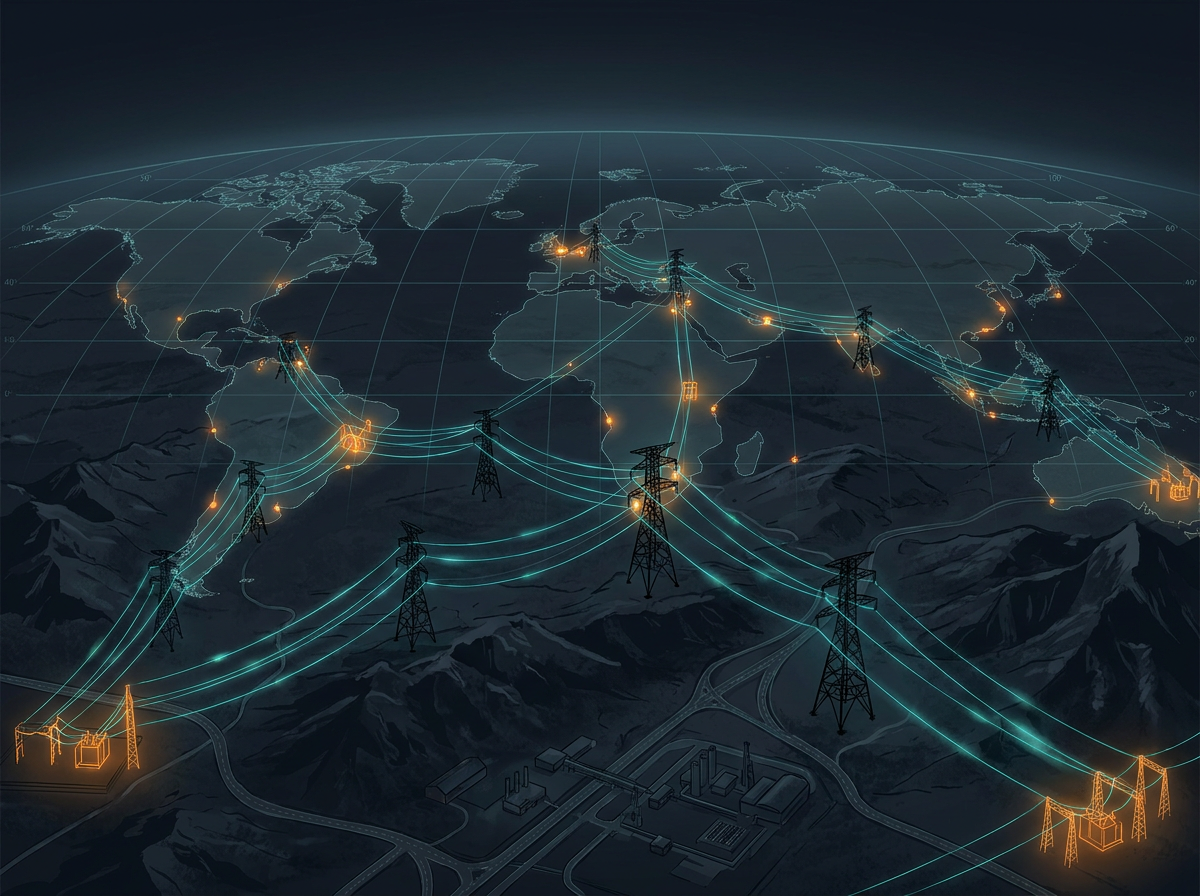
There are weeks when the news reads like a checklist of unrelated events. And then there are weeks when five stories from five different corners of the world all point to the same conclusion.
This is one of those weeks.
Texas just approved a $14 billion transmission buildout. Thailand just paused 166 data-center projects. China injected $54 billion into its state financial system. Iran and OPEC+ are making diesel and petrochemical feedstocks an inflation wildcard again. And a German startup launched the first commercial orbital rocket from continental Europe.
On the surface, these stories have nothing to do with each other. Beneath the surface, they are all variations on the same theme: the competitive advantage in industrial location is no longer about who has the cheapest land. It is about who can actually deliver reliable infrastructure.
Texas Rewrites the Playbook on Transmission as Economic Development
Let's start with the headline that matters most if you are in the business of placing industrial projects.
Texas regulators approved roughly $14 billion in high-capacity transmission expansion in the Permian Basin, with statewide grid investment potentially reaching $33 billion. Electricity demand in the Permian is projected to quadruple by 2032, driven by oil-and-gas operations, electrification, and — unsurprisingly — data centers.
For decades, industrial recruitment meant getting a project to the utility network. The utility network was infrastructure that already existed. Your job was to identify sites close enough to tap it.
That model is increasingly obsolete.
What Texas is doing — deliberately spending billions to build transmission infrastructure ahead of confirmed demand — is a fundamental reframe of what economic development infrastructure looks like. Roads, water, and sewer used to define a shovel-ready site. Power delivery is now in that same category, and the states and utilities that treat it that way are the ones that will attract the next wave of hyperscale and heavy industrial investment.
There is a political friction point worth naming honestly: landowners and rural communities along these corridors are bearing real costs — easements, land-use disruption, risk — while the primary beneficiaries are often large energy users and tech companies. That tension is not going away. But the states willing to work through it are building a structural advantage that will compound for years.
The practical takeaway for site selection: a transmission project that is funded, permitted, and under construction is a fundamentally different asset than a utility map showing “planned” capacity. Know the difference. Your clients definitely will.
Thailand's Data-Center Pause Is a Preview, Not an Outlier
Thailand just put 166 data-center projects on hold — 49 already under construction, 117 in the approval queue — while the government builds a national framework for electricity use, water consumption, site selection, and environmental impact.
The instinct from some quarters will be to read this as a Southeast Asian regulatory quirk. That instinct is wrong.
Thailand is experiencing in accelerated form what U.S. communities are beginning to work through: what happens when infrastructure-intensive industrial projects arrive faster than policy can absorb them.
The old question that shaped data-center incentive packages was simple: How much investment and tax revenue does this project bring?
The question is shifting: What does the community net out after accounting for power demand, water draw, grid upgrades, land consumption, and long-term infrastructure carrying costs?
Communities are not wrong to ask it. Forty hyperscale data centers landing in the same utility service territory is a fundamentally different policy challenge than one. The incentive math that looks reasonable on an individual project basis can become politically unsustainable at scale.
The likely long-term result — both internationally and domestically — is more capacity allocation, infrastructure-cost sharing, and performance requirements tied to hyperscale development. That makes genuine site readiness increasingly valuable. It also makes speculative sites with no credible utility delivery path increasingly vulnerable.
If you are developing or marketing sites for data-center use, the sites that will survive this tightening environment are the ones with documented, defensible infrastructure plans — not pitch decks with power claims that have not been stress-tested.
China's Bank Recapitalization and the Overcapacity Risk No One Wants to Say Out Loud
China's Ministry of Finance announced $54 billion in capital injections into major state-owned banks and insurers. Three large state banks will receive roughly 290 billion yuan combined. China Life, China Taiping, and other state insurers are also receiving fresh capital.
Beijing's official rationale: strengthen capital ratios, improve resilience, support lending.
The honest read: China's private economy is weak, loan demand is soft, and the government is using the state balance sheet to prevent financial deterioration from becoming a broader economic crisis.
There is an important distinction that gets lost in most coverage of moves like this. Capital support and genuine demand are not the same thing. You can capitalize a bank until it is bulletproof, but that does not create profitable borrowers. If Chinese households and companies are still reluctant to take on debt, you end up with stronger banks sitting in front of a stagnant private economy.
For U.S. industrial strategy, the relevant downstream risk is this: stronger Chinese state banks enable continued financing of manufacturing capacity expansion and export-oriented production — precisely the dynamic behind growing Western concern about Chinese overcapacity in steel, solar, EVs, and advanced manufacturing.
That is not a reason to panic. But it is context for understanding why supply chains that run through or depend on Chinese industrial capacity carry a different risk profile today than they did five years ago. Companies doing serious site selection work should be modeling that risk, not treating it as background noise.
Oil Shocks and the Macro Environment That Will Shape CapEx Decisions
U.S. forces struck three Iranian crude-oil tankers after Iran launched ballistic missiles at U.S. Navy ships. OPEC+ kept October production policy unchanged. Hormuz shipping is disrupted. And the most recent U.S. jobs report strengthened the case for the Fed to remain restrictive.
Alone, any one of these developments is manageable. Together, they sketch a macro environment that should be on the radar of anyone advising on major capital investment decisions.
The oil market now faces three simultaneous supply constraints: Iranian exports are impaired, Strait of Hormuz shipping is disrupted, and OPEC+ is not riding to the rescue with a major production increase. If crude stays elevated, the effects are not confined to gasoline prices. Diesel affects trucking, rail, agriculture, and construction. Petrochemical feedstocks affect manufacturing input costs. Higher inflation complicates monetary policy. Higher Treasury yields make commercial real estate financing more expensive.
The worst-case macro combination — strong labor market, oil shock, elevated inflation, restrictive Fed — is not a tail risk right now. It is a scenario that deserves to be in the base case range for project financial models.
This does not mean major industrial projects stop. Companies with long investment horizons understand that macro cycles exist. But it does mean that projects with marginal financial cases get harder to move forward, and that sites with genuine infrastructure advantages are better positioned to win the deals that do proceed.
Europe's Commercial Launch Moment and What It Tells Us About Strategic Supply Chains
German startup Isar Aerospace launched its Spectrum rocket into orbit from Norway's Andøya Spaceport — the first commercial orbital launch from continental Europe. The company has five more rockets in production, a Nova Scotia launch site planned for 2028, and roughly €200 million in European Space Agency backing.
The space story is notable on its own terms, but the more interesting signal is what it represents at a policy level.
Europe has spent years dependent on a small number of launch systems and foreign providers. Building a commercial launch ecosystem changes that — and the logic behind it mirrors what is happening in terrestrial industrial policy across multiple sectors.
Governments increasingly want domestic or allied control over strategically important infrastructure rather than relying on a single foreign supplier. That is visible in semiconductor reshoring, battery manufacturing investment, critical mineral processing, and now commercial space. The underlying thesis is consistent: supply chains that depend entirely on foreign-controlled chokepoints carry strategic risk that cannot be adequately priced until the risk materializes.
For economic developers and site selectors, this is a useful frame. The industries most likely to drive major investment over the next decade — advanced manufacturing, energy infrastructure, defense supply chains, data and AI infrastructure — are precisely the industries where governments and companies are most focused on supply-chain resilience. Understanding where your region or your site fits into that logic is increasingly the job.
The Thread That Connects All of It
Power and energy infrastructure are the central industrial-location variable right now. Full stop.
Texas is spending $14 billion to build it. Thailand is pausing projects because demand outran it. China is reinforcing its financial system to sustain its capacity to build it. The Iran conflict is exposing the downstream risks when energy supply chains are disrupted. Europe is building independent space infrastructure for the same reason domestic manufacturers are reshoring: because supply-chain control is strategic, not just economic.
The shift is not subtle. It is not incremental. And it is not going to reverse when the current news cycle moves on.
The question that used to define competitive industrial location was: Where is the cheapest place to build?
The question that defines it today is: Where can this project obtain reliable infrastructure and strategic inputs at an acceptable long-term risk?
Those two questions produce very different answers. The economic developers and site selectors who are sharpest on that distinction — who can document not just what infrastructure exists, but what can credibly be delivered, when, and at what cost to the project — are the ones who will be most useful to clients navigating this environment.
The headline incentive competition is not going away. But it is becoming less determinative. Infrastructure delivery is the game.
Navigating an infrastructure-sensitive project? Let's talk.
Start a Conversation