
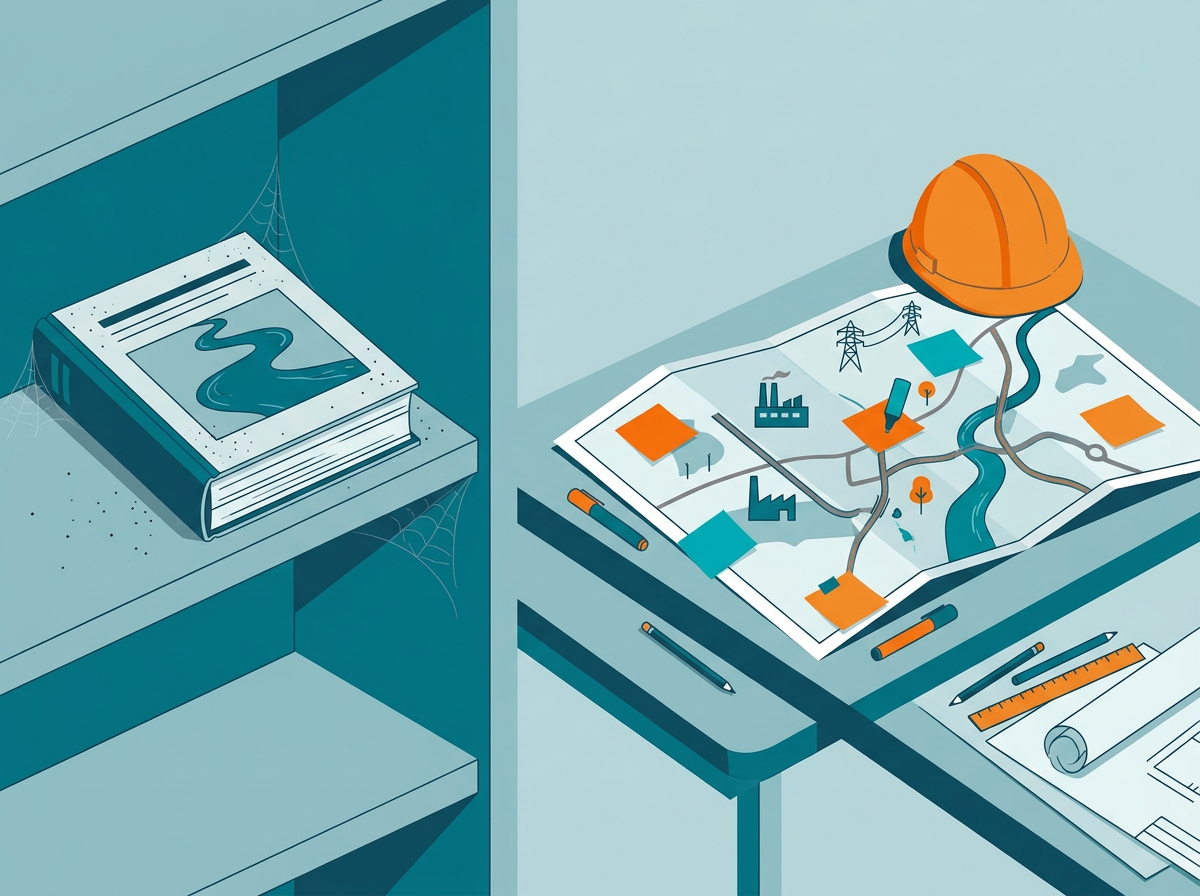
Most regions write a CEDS to stay eligible for federal money and then put it on a shelf. With EDA's future back on the budget chopping block, that is a bad trade. Here's how to build one that earns its keep either way.
Every five years, most regions in America produce a document that almost nobody outside the region reads.
It is called a Comprehensive Economic Development Strategy, or CEDS, and it is the terms-and-conditions screen of economic development. Everyone knows it matters. Everyone scrolls to the bottom and clicks “Agree.”
I have spent about fifteen years on both sides of the table, inside state and local economic development and now advising companies and communities on where large projects go. In that time I have seen very few CEDS documents that a site selector would open on purpose. That is a missed opportunity, because a CEDS done well is the closest thing most regions have to a business plan. Done poorly, it is a grant prerequisite with a cover photo of a river.
This post covers what a CEDS actually requires, why most of them stall, and how to write one that keeps paying off whether or not the federal check arrives.
What a CEDS Is, in 90 Seconds
A CEDS is the regional economic development plan the U.S. Economic Development Administration (EDA) uses to decide whether a region is ready for its investment. It is a prerequisite for designation as an Economic Development District, and EDA generally expects one before funding Public Works and Economic Adjustment Assistance projects.
The federal rule (13 C.F.R. § 303.7) requires four elements:
- 1A summary of the region's economic development conditions
- 2An analysis of strengths, weaknesses, opportunities, and threats (the SWOT)
- 3Strategies and an implementation plan that build on the strengths, address the weaknesses, and don't conflict with state and local economic or workforce strategies
- 4Performance measures to evaluate how well the CEDS is developed and implemented
The process rules matter too. A CEDS must come out of a continuing planning process with broad public and private participation. It must sit out for public comment for at least 30 days before submission. EDA-funded planning organizations owe an annual performance report and a new or revised CEDS at least every five years, or sooner if circumstances change.
That is the floor. EDA's own content guidelines describe everything beyond it as aspirational rather than required, and that is exactly where most regions stop.
Planning-level summary only, not legal advice. Confirm current requirements with your EDA regional office before you scope an update.
Why Most of Them End Up on a Shelf
The failure pattern is remarkably consistent.
The SWOT could describe anywhere
“Strong work ethic” is a strength. “Workforce availability” is a weakness. “Central location” shows up in regions that are, geographically speaking, nowhere near the center of anything. If you can swap the county name and the SWOT still reads true, it says nothing.
The action plan has forty goals and no owners
Committees are good at adding priorities and bad at cutting them. The result is a list where “expand broadband” and “support entrepreneurship” sit next to “develop a 500-acre industrial park” with the same weight, no budget, no lead agency, and no date.
The performance measures count activity
Meetings convened, plans adopted, partners engaged. None of that tells a board, a utility, or a prospect whether the region is more competitive than it was five years ago.
It is written for the reviewer
The real audience is an EDA regional office checking boxes. Everyone else who could use the document, including the people deciding where a $200 million plant goes, is an afterthought.
The Uncomfortable Context: The Federal Check Is Not Guaranteed
Here is the part worth saying out loud. If your CEDS only has value as a ticket to EDA funding, its value now depends on appropriations politics.
Congress reauthorized EDA in January 2025 and funded it at $466 million for FY2026, about flat with the prior year. The Administration, however, proposed closing the agency in both its FY2026 and FY2027 budget requests, and the Congressional Research Service reports EDA's workforce had dropped to 190 employees as of June 2026.
“A CEDS built to be used locally keeps its value either way. A CEDS built only to be accepted does not.”
I am not predicting EDA's demise. Congress has protected it through plenty of proposed eliminations before. But a smart region plans for both outcomes.
Five Ways to Make It Useful
1. Write the SWOT like a site selector will read it
Because one eventually will, at least in spirit. During desk review, consultants find the weaknesses whether you list them or not: the substation that's out of capacity, the labor shed that is already tapped by two large employers, the sewer plant at 90 percent.
Name them specifically. “Infrastructure needs” is filler. “No site over 100 acres with 20 MW deliverable inside 36 months” is a finding, and it tells everyone what to fix. Specific weaknesses also make better grant narratives, because they connect directly to a fundable project.
2. Turn the action plan into a project pipeline
The implementation plan is the only place in most regions where infrastructure, workforce, and land priorities live in one document. Treat it like a capital plan.
For each priority project, list the site or corridor, the gap it closes (power, water, sewer, access, entitlement), an order-of-magnitude cost, the lead entity, the funding stack beyond EDA (state programs, utility economic development riders, TIF, local bonds), and a target readiness date. If a project has no owner and no money identified, it is a wish, and it belongs in an appendix. (For more on what readiness actually means to a buyer, see What “Shovel-Ready” Actually Means for Site Selection.)
3. Pick fewer targets and say no to the rest
A CEDS that targets advanced manufacturing, logistics, life sciences, agribusiness, tourism, tech, and “emerging industries” has not chosen anything. Anchor the strategy to a real target industry analysis that is willing to exclude sectors the region can't win today. A short list is a strategy. A long list is a census. (More here: Targeted Industry Studies: A Practical Guide to Picking Industries You Can Actually Win.)
4. Measure outcomes you can actually move
Replace activity counts with a handful of competitiveness metrics the region controls or strongly influences. Some examples worth considering:
- Acres of certified or fully served industrial land available
- Megawatts deliverable to marketed sites, and on what timeline
- Share of qualifying RFIs where the region had a responsive site
- Days from prospect inquiry to complete response
- Completion rate on the action plan's priority projects
These are illustrative, not a federal standard. The point is that each one would change a site selector's opinion of the region if it moved.
5. Give it an owner and a calendar
The annual performance report is usually treated as paperwork. Make it a standing board agenda item instead: what moved, what stalled, what changed. And use the rule's own flexibility. The regulation allows a revision before the five-year mark when circumstances change. A new data center campus that absorbs your remaining grid headroom is a changed circumstance. Update the plan when the region changes, not when the calendar says so.
The Ten-Minute Test
Before you send your next CEDS out for public comment, hand it to someone who doesn't work in economic development: a utility planner, an industrial developer, a corporate real estate director. Give them ten minutes.
Can they find where the region's best sites are, what is being built to improve them, what is still missing, and who to call? If the answer is yes, you have a recruitment tool that also satisfies EDA. If the answer is no, you have a compliance filing.
Same process, same public meetings, same five-year cycle. The difference is who you write it for.
Planning a CEDS Update?
If your region has a CEDS update coming in the next year or two, the scoping decisions you make now determine whether you get a shelf document or an operating plan. Hyphen Strategies helps EDOs and planning organizations build the pieces that make a CEDS useful: target industry analysis, regional utilities studies, and site readiness strategy, all delivered principal-led on a fixed-fee basis. Get in touch to talk through your timeline.
Talk Through Your TimelineWant more conversations like this? Listen to the Site Selectors Are People, Too podcast.