
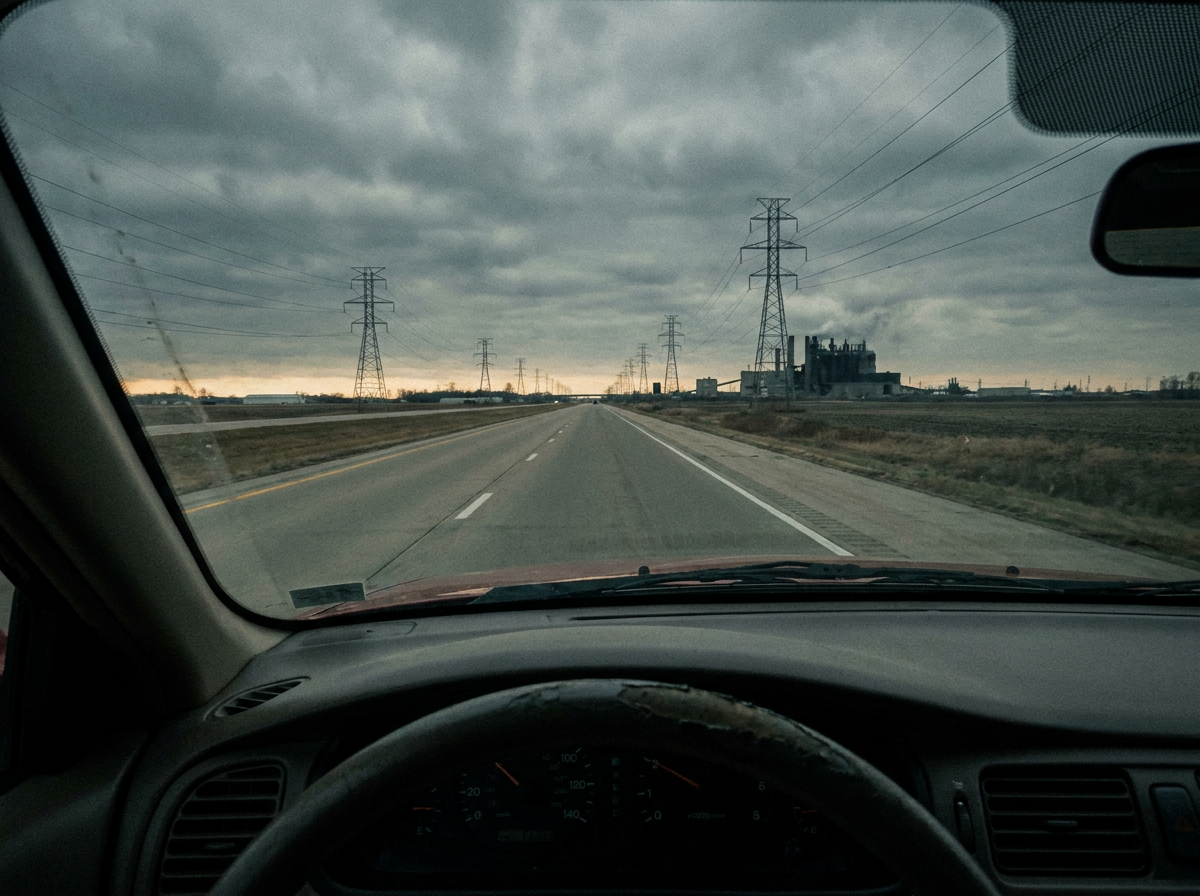
There's a version of business travel that looks great on Instagram — airport lounges, city skylines, expense-account dinners with a view. That's not site selection travel.
Site selection travel looks like a 5:45 a.m. flight to a mid-sized regional airport, a rental car that smells like someone else's fast food, and a full day of back-to-back site tours across roads that Google Maps confidently calls “highways.” You're not sightseeing. You're evaluating whether a 500,000-square-foot shell building can handle the power load a client needs, and whether the wastewater treatment plant three miles away has the capacity to absorb what they'll discharge.
It's not glamorous. But it is essential — and it's often where the real work happens.
What You Actually See on a Site Visit
There's no substitute for being on the ground. I've used satellite imagery, aerial photography, environmental databases, and municipal infrastructure reports. I've read the utility capacity studies and reviewed the fiber maps. And I can tell you from experience that none of them tell the whole story.
You learn that the “flat, shovel-ready” site has a drainage swale running through the middle of the developable area that doesn't show up cleanly on any map. You learn that the “adjacent rail spur” is technically adjacent — but hasn't carried freight in a decade and the landowner has no intention of negotiating. You learn that the economic development director who sounded lukewarm on the phone is, in person, exactly the kind of committed partner a company needs in a state incentive negotiation.
You also learn the opposite. You learn that the community's enthusiasm outpaces its infrastructure. You learn that what was presented as a “ready-to-develop” site has an environmental issue that wasn't in the Phase I. You learn, standing in a conference room with a county assessor and a utilities engineer, that the numbers don't work — and that the client needs to hear that directly.
These are the fatal flaw moments. And they don't happen on Zoom.
The Physical Reality Nobody Talks About
FAM tours — familiarization tours, where economic development organizations bring consultants in to showcase their region — are a staple of this industry. They're genuinely valuable. They're also exhausting in a way that doesn't always get acknowledged.
A well-organized FAM tour is four days, six communities, ten site visits, three networking dinners, two roundtable discussions, and one early-morning flight home on which you will not sleep because you're writing notes from the day before. The catered lunch is a highlight. The third hotel room in three nights is not.
Multiply that across a year of site searches, regional utility studies, and client meetings, and you start to understand why a lot of people in this industry carry ibuprofen the way other people carry business cards.
There's also a mental load that's harder to quantify. You're the objective voice in a room full of people who all have something at stake — the client who needs certainty, the EDO that wants the project, the legal team watching the incentive language. Staying clear-headed and analytically sharp when you've been on the road for three days takes deliberate effort. The work doesn't get easier because you're tired.
I'm not complaining. I'm just being honest about what it takes.
The Moments That Make It Worth It
The payoff isn't usually dramatic. It's rarely a single conversation or a big reveal. It tends to accumulate.
It's the drive through a community where you can physically see the infrastructure alignment — the rail, the highway access, the substation, the available labor base — and you know before you've run a single model that this is a strong candidate. It's the meeting with a utility team where you realize they've done the homework and are prepared to move, and you make a note that this is a partner worth bringing back to the client.
It's the FAM tour that turns into a six-figure engagement eighteen months later because you showed up, asked good questions, and remembered the conversation.
The site selection process is fundamentally about reducing uncertainty for a client making a major capital investment. Some of that uncertainty gets resolved through data. A lot of it gets resolved through relationships — with EDOs, utility partners, engineers, community leaders. And those relationships are almost impossible to build at a distance.
There's a gap between what a community says it is and what it actually is. That gap closes when you show up.
Why Boots on the Ground Still Matters
We live in an era of remarkable remote capability. I can pull utility capacity data, workforce analytics, and environmental risk layers without leaving my desk. I can run a comparative analysis of six sites across three states before lunch.
But the clients who've hired me for the decisions that matter — the $300 million manufacturing facility, the data center requiring 200 megawatts of committed power, the distribution hub anchoring a regional logistics network — they're not paying for the analysis alone. They're paying for the judgment that comes from knowing what the analysis can't capture.
That judgment comes from the field. From the site visits and the FAM tours and the Tuesday morning rental car on a state highway in a county most people couldn't find on a map.
That's where the work is. That's where I go.
Planning a site search or FAM tour? Let's talk.
Start a Conversation