
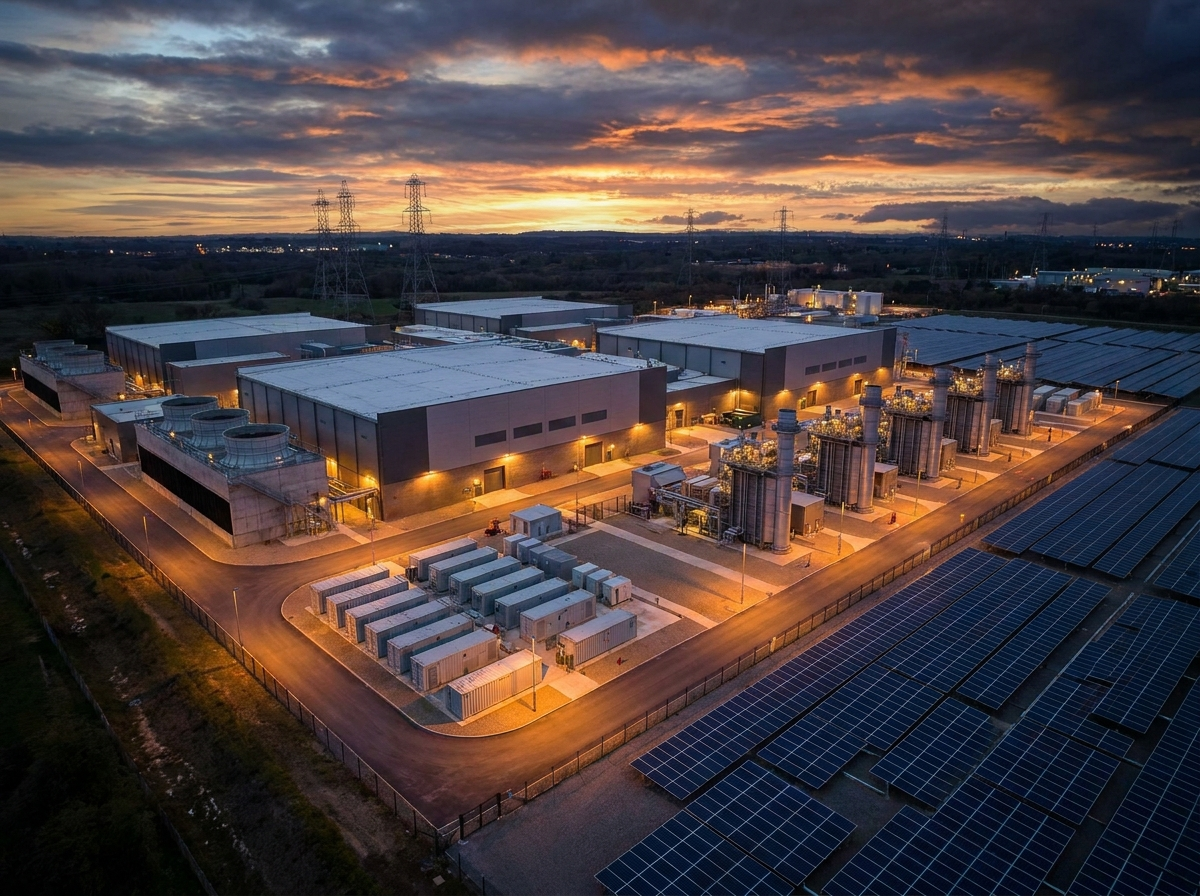
There is a phrase that has been circulating in data center development conversations for the past eighteen months that would have been treated as a novelty two years ago and is now showing up in serious project underwriting: “grid-optional.”
It does not mean what it sounds like. Most data center projects described as grid-optional are not, in practice, planning to operate entirely without utility power. What it means — in the way developers and their EPC partners are actually using the term — is that the project is structured so that utility interconnection is not on the critical path. The facility can reach commercial operation, generate revenue, and serve workloads before the interconnection queue delivers power at scale. The grid is there if needed. It is not the condition on which the project's economics depend.
That shift in framing is not a marketing exercise. It is a response to a specific, structural problem: interconnection timelines in the markets where data center demand is highest have stretched well past the development horizons that institutional capital can tolerate. When the queue math does not work, projects do not wait. They route around the constraint.
Understanding what that routing looks like — the technologies involved, the siting implications, the regulatory landscape, and where the genuine complexity lies — is increasingly necessary for anyone advising on or competing for large data center projects.
What Changed, and When
Behind-the-meter generation is not a new concept in the data center context. Diesel backup generators have been standard in mission-critical facilities for decades. Large UPS systems, automatic transfer switches, redundant feeds from the utility — all of it is mature, understood infrastructure.
What has changed is the scale and the intent. The backup generator conversation was always about resilience: what happens when grid power fails, and how does the facility sustain operations for the hours or days required to restore it? The emerging BTM conversation is about a different question entirely: what if the facility does not depend on grid power as its primary source at all?
That question became financially meaningful when interconnection timelines in PJM, MISO, and SERC started running three to five years for large load projects. A developer evaluating a site in 2021 could underwrite a reasonable timeline to power. A developer evaluating the same site today is looking at a queue position that may not clear until 2029 or 2030, against a capital deployment schedule that assumed operations beginning in 2027. The arithmetic does not work. And when arithmetic does not work, capital moves.
The movement has produced a genuine diversification in how serious development teams are thinking about power supply. Natural gas-fired generation — peakers, combined heat and power systems, and distributed gas turbines — has re-emerged as a primary power strategy for large campuses, particularly in markets where gas supply infrastructure is reliable and the permitting environment for new combustion is manageable. Solar-plus-storage has graduated from sustainability commitment to operational power strategy in sunbelt markets with sufficient irradiance and land. Long-duration storage is advancing faster than most utility planning departments have updated their interconnection models to reflect. And small modular reactors, which have spent years as a talking point, are now the subject of executed land acquisition agreements and formal development timelines at a small but growing number of hyperscale campuses.
None of these is simple. All of them are real.
What BTM Actually Encompasses
The term “behind-the-meter” covers a wide range of configurations, and the siting implications of each are meaningfully different. Treating BTM as a single strategy is the kind of imprecision that produces bad site decisions.
At one end of the spectrum is distributed peaking generation — natural gas turbines or reciprocating engines sized to cover baseload or near-baseload demand, collocated with the data center campus. This configuration is closest to the legacy diesel backup model in terms of permitting and siting familiarity, but it operates at an entirely different scale. A 200 MW campus powered primarily by on-site gas generation is permitting a power plant, not a generator set. Air quality permits, noise impact assessments, fuel supply agreements, and interconnection with the local gas distribution system are all material project considerations. The development timeline for the power component can rival the timeline for the data center itself.
At the other end is the microgrid or hybrid supply strategy: a combination of renewable generation, battery storage, and a minimal utility connection structured so the facility can island — operate independently from the grid — when grid conditions are unfavorable and draw utility power when the economics favor it. This configuration is more complex to design and operate but can satisfy both operational reliability requirements and sustainability commitments that pure gas generation cannot. It is also less dependent on a single fuel supply chain, which has become a more explicit consideration since 2021.
Between those poles is everything from fuel cells to direct-drive renewables to, in a handful of serious but still early-stage projects, small modular reactors. SMRs are genuinely differentiated from the rest of this discussion: they offer baseload power at high capacity factor without combustion emissions, but they also require Nuclear Regulatory Commission licensing, site characterization, and development timelines that put them in a category of their own. The projects that are currently advancing SMR development at data center campuses are not typical site selection exercises. They are long-duration infrastructure bets made by operators with multi-decade asset horizons and capital structures that can absorb the front-end development risk.
For most projects operating on a standard development timeline, the realistic BTM options are natural gas generation, solar-plus-storage, or a hybrid of the two. The right answer depends on market-specific factors — gas supply reliability and price stability, renewable resource quality, permitting environment for each technology, and the project's specific reliability and sustainability requirements — not on a universal preference for one approach.
How BTM Changes the Site Selection Calculus
If BTM is a genuine primary power strategy rather than a backup supplement, it fundamentally changes what a site selection analysis is optimizing for. The variables that determined site quality in a grid-dependent evaluation are not the same ones that determine it in a BTM evaluation.
In the grid-dependent model, proximity to transmission infrastructure was the organizing constraint. The screening question was: how close is this site to a substation that can support the load, and what is the realistic timeline to interconnection? Everything else was downstream of that answer.
In a BTM model, that question becomes secondary. The screening questions shift to the energy supply infrastructure that supports on-site generation. For natural gas BTM, the relevant variable is pipeline capacity and delivery pressure at or near the site: not whether gas is available in the region, but whether it can be delivered to the site at the volume and pressure required for industrial-scale combustion. Pipeline capacity constraints in markets with high demand concentration — the Mid-Atlantic, parts of the Midwest — are a real siting variable that most economic development organizations cannot assess without utility partnership and are not currently including in site marketing materials.
For solar-plus-storage BTM, the relevant variables shift again: solar resource quality (which varies meaningfully across North American geographies in ways that matter at the project's scale), available land for generation and storage, grid interconnection for export or backup (even a grid-optional project typically benefits from a smaller interconnection for balancing), and the regulatory treatment of behind-the-meter generation in the relevant jurisdiction. Some utility tariff structures and state regulatory frameworks are significantly more accommodating of BTM strategies than others, and that regulatory environment is now a real differentiation factor between competing markets.
The permitting environment for on-site generation is a consideration that is consistently underweighted in early-stage site evaluation. Air quality permits for combustion generation in non-attainment areas can add eighteen months or more to a project timeline. Local zoning for energy generation facilities is not uniform and is not always aligned with data center zoning approvals. Noise and visual impact requirements vary by jurisdiction. A site that clears the typical data center siting checklist can still be functionally constrained for BTM development by permitting factors that were not part of the original evaluation.
The Translator Problem
One of the consistent challenges in BTM project development is that the parties with the most relevant expertise are rarely in the same room at the right time. The data center developer's real estate and site selection team understands location, permitting, and incentives. The EPC partners who will actually build the power infrastructure understand construction and engineering. The utility economic development team understands the grid. The regulator understands neither the project's operational requirements nor the grid's current constraints in terms that map to each other without translation.
The resulting dynamic is predictable: project timelines slip because a permitting assumption made by the real estate team was not validated with the EPC partner, or because an interconnection approach proposed by the utility did not account for the project's actual operational requirements, or because the regulatory filing strategy developed by counsel did not reflect the technical parameters the power engineering team needed to preserve flexibility.
This is not a criticism of any of those parties individually. It is a description of what happens when a project requires expertise that spans multiple disciplines, and the integration of that expertise happens later than it needs to. BTM projects require that integration earlier than grid-dependent projects do, because the decisions made in the first sixty days of a BTM site evaluation — about power supply configuration, permitting strategy, and utility relationship management — constrain the options available in the following twelve months in ways that are very difficult and expensive to reverse.
The value of advisory work in this environment is not in any single technical domain. It is in understanding enough about each domain to recognize when the assumptions being made in one are creating problems for another, and in being able to facilitate the conversation between parties who are not, by default, speaking the same language.
What Communities Need to Understand
Economic development organizations are still largely organized around the grid-dependent model of data center attraction. The marketing materials emphasize substation proximity, available megawatts, and utility rate structures. That framework is not wrong — those variables still matter — but it is increasingly incomplete for a segment of the market that is evaluating sites on a different set of criteria.
Communities that want to compete for BTM-capable projects need to develop fluency in energy supply infrastructure beyond the substation. That means understanding the gas transmission and distribution network serving their candidate sites well enough to speak to pipeline capacity and delivery parameters. It means understanding the solar and storage resource environment in their market and having a preliminary answer to the question of what a behind-the-meter renewables configuration looks like at scale. It means understanding the permitting environment for on-site generation, including air quality attainment status, local zoning, and the realistic timeline for the permits that would govern a significant on-site combustion or storage installation.
None of that is easy, and most communities are not going to develop that expertise internally. The economic development directors who are winning BTM projects are the ones who have built the relationships — with utility engineering teams, with the relevant regulatory agencies, with EPC firms who understand the technology — so that when the question comes, they can assemble a credible technical answer rather than offering to look into it.
The communities that treat BTM as a developer problem — interesting to watch, but not something the community needs to engage with directly — are going to find that the projects they were pitching for five years ago have left the market. The developers who can execute BTM strategies are not dependent on the community's grid preparation in the way that earlier generations of data center investment were. If the community cannot add value to the power equation, the reasons to choose it narrow significantly.
Grid-Optional Is a Strategy, Not a Workaround
The framing that is most useful here — and the one that is most often missing from the discussion — is that BTM and grid-optional strategies are not a developer's response to a bad grid situation. They are, in a growing number of cases, the preferred approach when the developer has the capital and operational capability to execute them.
The economics of on-site generation have shifted enough that a well-structured BTM project can achieve all-in power costs competitive with grid tariffs over a long operating horizon, while eliminating the queue delay risk that is the most significant project risk in many markets. For operators with large enough campuses to justify the development cost, that trade is increasingly attractive even in markets where grid interconnection would theoretically be available on a reasonable timeline.
What that means for the industry is that BTM is not a temporary solution that will become less relevant as the grid improves. It is a permanent feature of the data center power landscape, driven by economics and operational preferences that will persist regardless of what happens with interconnection reform. Understanding it — not as a fallback, but as a primary strategy that reshapes the siting evaluation from the first day — is now part of the minimum competency required to operate in this market.
The grid conversation that matters now is not about whether a site has power available. It is about how a project gets to power on the timeline and at the cost the project requires. For an increasing share of the market, the answer to that question does not go through the interconnection queue at all.
Advising on a BTM project or evaluating sites for grid-constrained markets?
Start a Conversation